
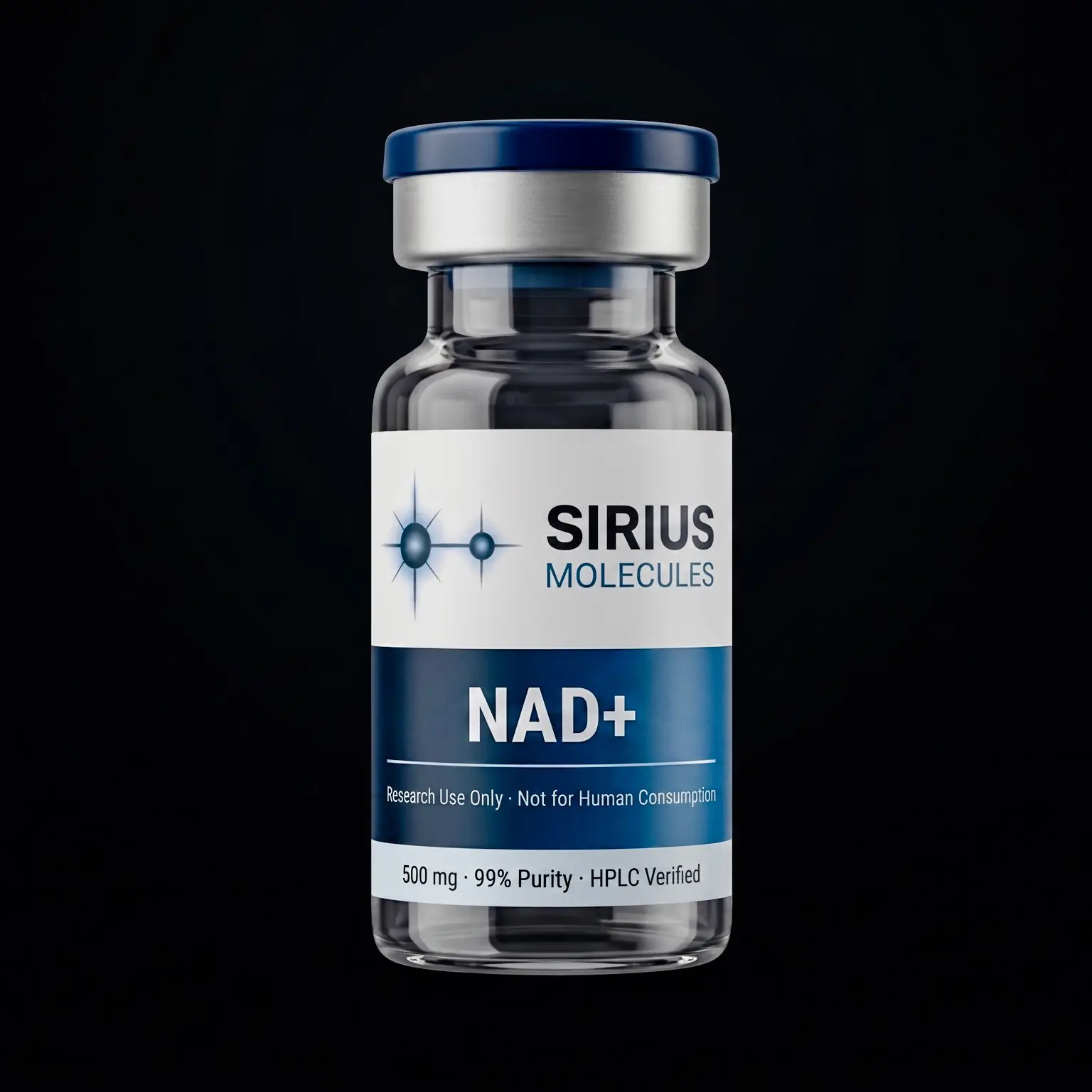
Overview
Nicotinamide Adenine Dinucleotide (NAD+) is a pyridine dinucleotide coenzyme essential for electron transfer reactions across cellular metabolism. As a research reference compound, NAD+ has been studied extensively in preclinical models for its roles in mitochondrial function, sirtuin pathway activation, PARP-mediated DNA damage response, and redox biology (Belenky et al., 2007 — PMID: 17350155).
History
NAD+ was first described in the early 20th century as a cofactor in cellular respiration. Research into NAD+ biology expanded dramatically in the 2000s with the characterization of sirtuins as NAD+-dependent deacetylases. More recent research has focused on age-related NAD+ decline, its implications for mitochondrial function, and the investigation of NAD+ precursors and direct NAD+ supplementation in preclinical models (Canto et al., 2015).
Structure & Molecular Data
| CAS Number | 53-84-9 |
| Molecular Formula | C₂₁H₂₇N₇O₁₄P₂ |
| Molecular Weight | 663.43 g/mol |
| Amino Acid Count / Structure | N/A — coenzyme/dinucleotide |
| PubChem CID | 5893 |
| Sequence | Nicotinamide-adenine-dinucleotide (not a peptide) |
| Appearance | Lyophilized white-to-off-white powder |
| Storage | Store at -20°C. Protect from light and moisture. |
| Solubility | Soluble in sterile water |
Compound Class & Mechanism
NAD+ functions as a coenzyme in hundreds of enzymatic reactions across cellular metabolism, accepting and donating electrons between oxidized (NAD+) and reduced (NADH) states. In preclinical research, NAD+ availability has been associated with regulation of glycolysis, the TCA cycle, oxidative phosphorylation, and fatty acid oxidation pathways.
Beyond its role in electron transfer, NAD+ serves as a substrate for sirtuins (SIRT1-7), poly-ADP-ribose polymerases (PARPs), and CD38, all of which consume NAD+ in their enzymatic activities. Research has documented these non-redox NAD+ consumption pathways as key determinants of cellular aging, DNA damage response, and metabolic signaling in preclinical models (Verdin, 2015 — PMID: 26785477).
Research Findings
NAD+ has been investigated across preclinical models spanning mitochondrial function, aging research, DNA damage response, and metabolic biology. Published research has documented findings in the following domains:
Key Research Areas
- Mitochondrial Research: NAD+ availability and mitochondrial biogenesis in preclinical models
- Sirtuin Pathway: SIRT1-7 enzymatic activity and NAD+ substrate dynamics
- DNA Damage Response: PARP-mediated DNA repair and NAD+ consumption research
- Aging Research: age-related NAD+ decline in controlled research models
Collectively, NAD+ occupies a central position in modern metabolic research, with research interest spanning mitochondrial biology, aging research, and stress response pathways. Its role as a substrate for multiple enzyme families makes it a foundational research reference compound (Rajman et al., 2018).
Research Context
Researchers study NAD+ to investigate mitochondrial function, sirtuin pathway dynamics, and age-related metabolic decline in preclinical models. The compound’s central role in cellular metabolism makes it foundational to a wide range of research domains including oncology, cardiovascular research, neurodegeneration models, and basic bioenergetics.
References
Belenky P. et al. (2007). NAD+ metabolism in health and disease. Trends in Biochemical Sciences. PMID: 17350155
Verdin E. (2015). NAD+ in aging, metabolism, and neurodegeneration. Science. PMID: 26785477
Canto C., Menzies KJ., Auwerx J. (2015). NAD+ metabolism and the control of energy homeostasis. Cell Metabolism.
Rajman L., Chwalek K., Sinclair DA. (2018). Therapeutic potential of NAD-boosting molecules. Cell Metabolism.
Yoshino J. et al. (2011). Nicotinamide mononucleotide, a key NAD(+) intermediate, treats the pathophysiology of diet- and age-induced diabetes in mice. Cell Metabolism.
Mills KF. et al. (2016). Long-term administration of nicotinamide mononucleotide mitigates age-associated physiological decline in mice. Cell Metabolism.
| REGULATORY & LEGAL NOTICE
Intended Use. This product is sold exclusively as a research chemical for use in controlled laboratory settings by qualified scientific professionals. It is intended solely for in vitro research, analytical standards, and non-clinical preclinical experimentation. The product is not a drug, dietary supplement, cosmetic, food product, or consumer article of any kind. Prohibited Uses. This product is NOT for use in humans, NOT for veterinary use, NOT for in vivo use in any species, NOT for diagnostic use, NOT for therapeutic use, NOT for food or agricultural use, and NOT for compounding into any preparation intended for administration to humans or animals. Qualified Professionals Only. Purchasers represent that they are qualified scientific professionals, licensed researchers, or authorized personnel at a research institution, and that this product will be handled in accordance with all applicable institutional, federal, state, and local regulations governing research chemicals. Regulatory Notice. The statements made regarding this product have not been evaluated by the U.S. Food and Drug Administration. This product has not been approved by the FDA for any therapeutic, diagnostic, or preventive use. Not a Compounding or Outsourcing Facility. Sirius Molecules is a research chemical supplier. Sirius Molecules is not a compounding pharmacy or outsourcing facility as defined under Sections 503A or 503B of the Federal Food, Drug, and Cosmetic Act. Legal Compliance. Purchasers are solely responsible for ensuring that their acquisition, possession, handling, and use of this product complies with all applicable laws and regulations in their jurisdiction. |
Reviews
There are no reviews yet.