
Overview
Tesamorelin is a synthetic 44-amino-acid analog of native human growth hormone releasing hormone (GHRH), modified at the N-terminus with a trans-3-hexenoic acid moiety that confers resistance to dipeptidyl peptidase-IV (DPP-IV) degradation. The compound has been studied in preclinical and clinical research models for its role in GHRH-R-mediated pathway activation and visceral adipose tissue research (Falutz et al., 2007 — PMID: 17971457).
History
Tesamorelin was developed by Theratechnologies as a stabilized GHRH analog designed to overcome the short plasma half-life of native GHRH(1-29). Research has historically focused on metabolic pathway investigations, including studies characterizing changes in body composition parameters in HIV-associated lipodystrophy research models, as well as broader investigations of GH/IGF-1 axis dynamics (Dhillon, 2011).
Structure & Molecular Data
| CAS Number | 901758-09-6 |
| Molecular Formula | C₂₂₁H₃₆₆N₇₂O₆₇S |
| Molecular Weight | 5,135.79 g/mol |
| Amino Acid Count / Structure | 44-amino-acid GHRH analog with N-terminal modification |
| PubChem CID | 16137828 |
| Sequence | trans-3-hexenoyl-Tyr-Ala-Asp-Ala-Ile-Phe-Thr-Asn-Ser-Tyr-Arg-Lys-Val-Leu-Gly-Gln-Leu-Ser-Ala-Arg-Lys-Leu-Leu-Gln-Asp-Ile-Met-Ser-Arg-Gln-Gln-Gly-Glu-Ser-Asn-Gln-Glu-Arg-Gly-Ala-Arg-Ala-Arg-Leu-NH₂ |
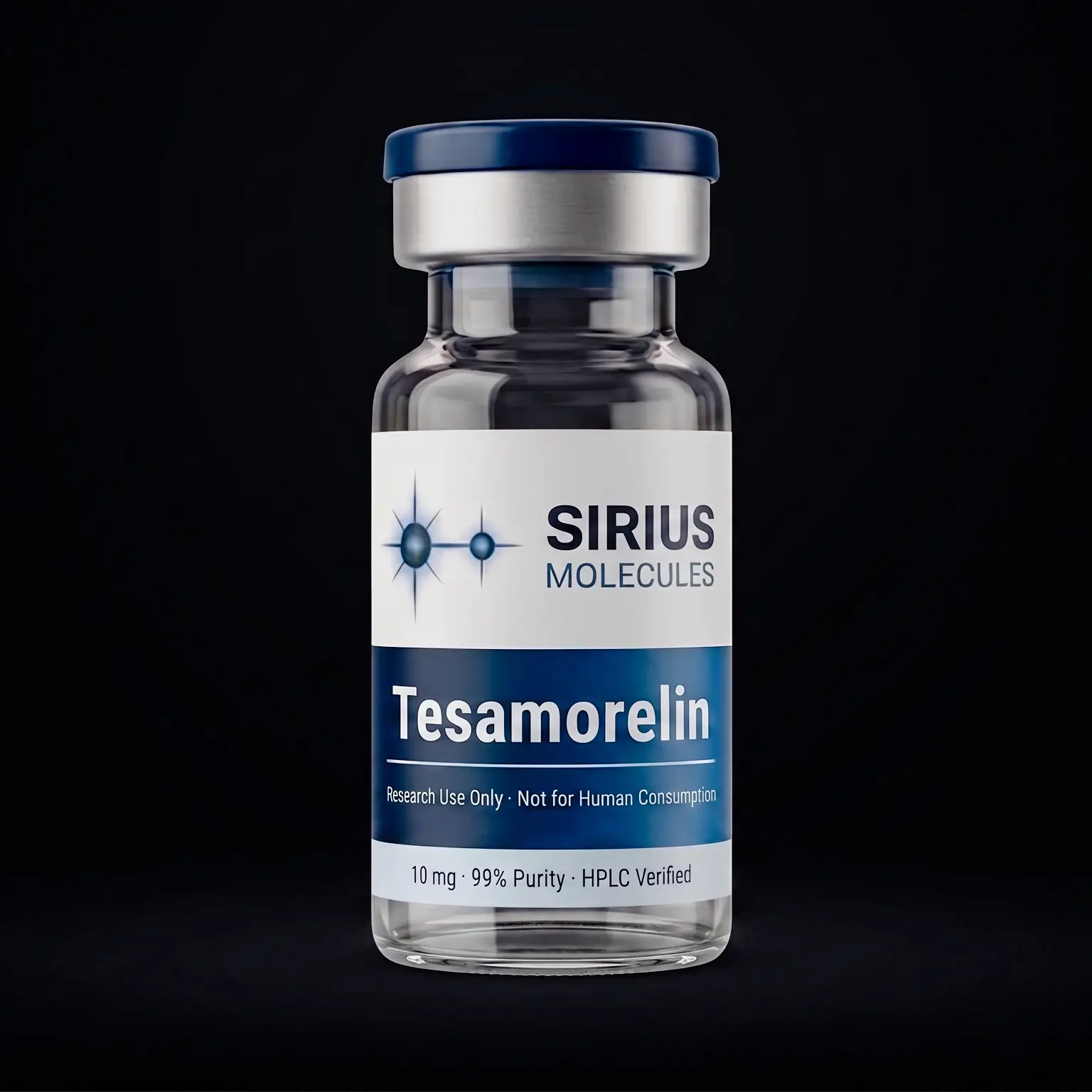
| Appearance | Lyophilized white powder |
| Storage | Store at -20°C. Refrigerate post-reconstitution for research use. |
| Solubility | Soluble in sterile water and bacteriostatic water for research preparation |
Compound Class & Mechanism
Tesamorelin binds to the GHRH receptor (GHRH-R) on anterior pituitary somatotrophs, activating cAMP-PKA signaling cascades in preclinical models. This pathway activation has been associated with pulsatile growth hormone release patterns and downstream IGF-1 pathway modulation in experimental settings.
The N-terminal hexenoic acid modification provides DPP-IV resistance, extending plasma stability relative to native GHRH(1-29). Research has characterized pharmacodynamic effects on visceral adipose tissue (VAT) parameters in preclinical and clinical investigation models, with particular focus on the mechanistic relationship between pulsatile GH elevation and adipose tissue metabolism (Falutz et al., 2007).
Research Findings
Tesamorelin has been investigated in preclinical and clinical research spanning metabolic, body composition, and endocrine systems. Published research has documented findings in the following domains:
Key Research Areas
- Adipose Tissue Research: visceral adipose tissue dynamics in metabolic research models
- GH/IGF-1 Axis: pulsatile GH release, IGF-1 response patterns in research protocols
- Metabolic Pathway Research: glucose and lipid metabolism in preclinical models
- Comparative GHRH Analog Studies: stability and selectivity profiles versus other GHRH analogs
Collectively, the research literature surrounding Tesamorelin has positioned it as a widely referenced GHRH-R agonist for investigating the relationship between GH axis activation and metabolic endpoints in controlled research settings (Stanley & Grinspoon, 2015).
Research Context
Researchers study Tesamorelin to investigate GHRH-R pharmacology, adipose tissue biology, and the metabolic consequences of pulsatile GH release. Its extended stability profile relative to native GHRH(1-29) makes it a frequently referenced tool in research designs requiring prolonged receptor activation while preserving endogenous pulsatile characteristics.
References
Falutz J. et al. (2007). Metabolic effects of a growth hormone-releasing factor in patients with HIV. NEJM. PMID: 17971457
Dhillon S. (2011). Tesamorelin: a review of its use in the management of HIV-associated lipodystrophy. Drugs.
Stanley TL., Grinspoon SK. (2015). Effects of growth hormone-releasing hormone on visceral fat, metabolic, and cardiovascular indices. Growth Hormone & IGF Research.
Ferdinandi ES. et al. (2007). Non-clinical pharmacology and safety evaluation of TH9507, a human growth hormone-releasing factor analogue. Basic & Clinical Pharmacology & Toxicology.
Clemmons DR. et al. (2017). Long-term effects of tesamorelin in HIV-infected patients with abdominal fat accumulation. Clinical Infectious Diseases.
Koutkia P. et al. (2004). Growth hormone-releasing hormone in HIV-infected men with lipodystrophy. JAMA.
| REGULATORY & LEGAL NOTICE
Intended Use. This product is sold exclusively as a research chemical for use in controlled laboratory settings by qualified scientific professionals. It is intended solely for in vitro research, analytical standards, and non-clinical preclinical experimentation. The product is not a drug, dietary supplement, cosmetic, food product, or consumer article of any kind. Prohibited Uses. This product is NOT for use in humans, NOT for veterinary use, NOT for in vivo use in any species, NOT for diagnostic use, NOT for therapeutic use, NOT for food or agricultural use, and NOT for compounding into any preparation intended for administration to humans or animals. Qualified Professionals Only. Purchasers represent that they are qualified scientific professionals, licensed researchers, or authorized personnel at a research institution, and that this product will be handled in accordance with all applicable institutional, federal, state, and local regulations governing research chemicals. Regulatory Notice. The statements made regarding this product have not been evaluated by the U.S. Food and Drug Administration. This product has not been approved by the FDA for any therapeutic, diagnostic, or preventive use. Not a Compounding or Outsourcing Facility. Sirius Molecules is a research chemical supplier. Sirius Molecules is not a compounding pharmacy or outsourcing facility as defined under Sections 503A or 503B of the Federal Food, Drug, and Cosmetic Act. Legal Compliance. Purchasers are solely responsible for ensuring that their acquisition, possession, handling, and use of this product complies with all applicable laws and regulations in their jurisdiction. |