Overview
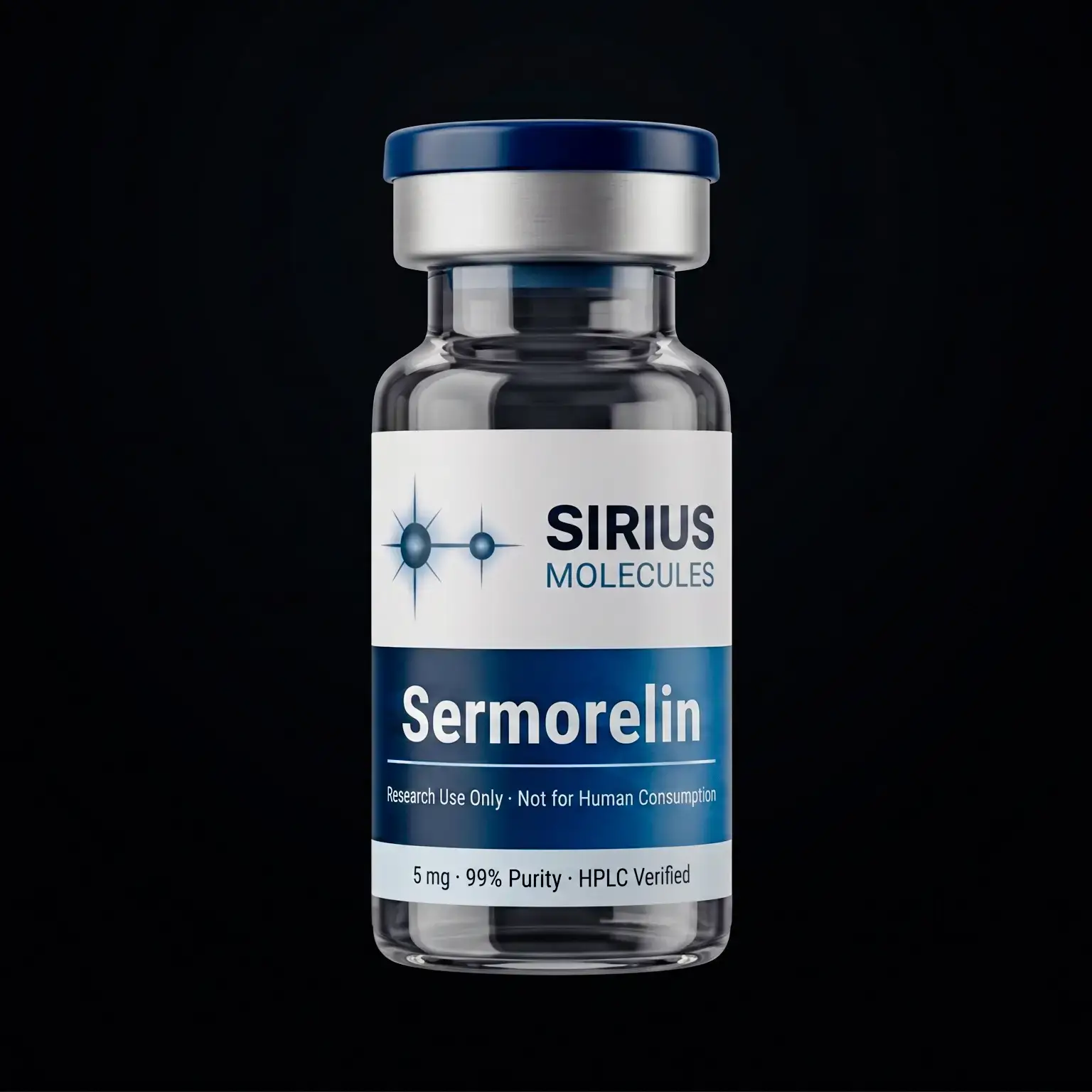
Sermorelin is a synthetic 29-amino-acid peptide corresponding to the biologically active 1-29 fragment of native human growth hormone releasing hormone (GHRH). It represents the shortest known GHRH sequence retaining full receptor agonist activity and has been studied extensively in preclinical and clinical research for its role in GHRH receptor pharmacology (Thorner et al., 1990 — PMID: 2106547).
History
The GHRH(1-29) fragment was characterized in the mid-1980s as part of research into the minimal structural requirements for GHRH receptor activation. Sermorelin was subsequently developed as a research and diagnostic tool for investigating the growth hormone-releasing axis, and remains one of the most widely referenced GHRH analogs in preclinical literature (Walker et al., 1996).
Structure & Molecular Data
| CAS Number | 86168-78-7 |
| Molecular Formula | C₁₄₉H₂₄₆N₄₄O₄₂S |
| Molecular Weight | 3,357.93 g/mol |
| Amino Acid Count / Structure | 29-amino-acid GHRH fragment (1-29) |
| PubChem CID | 16129618 |
| Sequence | Tyr-Ala-Asp-Ala-Ile-Phe-Thr-Asn-Ser-Tyr-Arg-Lys-Val-Leu-Gly-Gln-Leu-Ser-Ala-Arg-Lys-Leu-Leu-Gln-Asp-Ile-Met-Ser-Arg-NH₂ |
| Appearance | Lyophilized white powder |
| Storage | Store at -20°C. Refrigerate after reconstitution for research use. |
| Solubility | Soluble in bacteriostatic water and sterile water |
Compound Class & Mechanism
Sermorelin binds to GHRH receptors on pituitary somatotroph cells, activating Gs protein-coupled signaling and downstream cAMP production in preclinical models. This signaling cascade has been associated with stimulated growth hormone release patterns in experimental settings.
The native GHRH(1-29) sequence retains complete receptor affinity but has a shorter plasma stability than modified analogs due to susceptibility to DPP-IV cleavage at the Ala²-Asp³ bond. This short half-life makes Sermorelin a research tool for studying acute, pulsatile GHRH receptor activation (Frohman & Jansson, 1986).
Research Findings
Sermorelin has been investigated in a broad range of research contexts spanning pituitary function, pediatric endocrinology models, and adult GH pathway research. Published research has documented findings in the following domains:
Key Research Areas
- Diagnostic Research: GHRH receptor function testing in pituitary research models
- Pediatric Growth Research: investigation of GH axis development and function
- Adult GH Pathway Research: aging-related GH pathway changes in preclinical models
- Comparative GHRH Studies: native GHRH(1-29) as reference compound against modified analogs
Collectively, Sermorelin’s long history in research literature and its role as the benchmark minimal-active GHRH fragment have made it a widely referenced standard in preclinical GH axis research (Walker, 2006).
Research Context
Researchers study Sermorelin to investigate GHRH receptor pharmacology, pituitary function, and the minimal structural determinants of GHRH receptor activation. As the foundational GHRH(1-29) sequence, it serves as a comparator compound in studies evaluating modified GHRH analogs and combination protocols in preclinical settings.
References
Thorner MO. et al. (1990). Acceleration of growth rate in growth hormone-deficient children treated with human growth hormone-releasing hormone. Pediatric Research. PMID: 2106547
Walker RF. (2006). Sermorelin: a better approach to management of adult-onset growth hormone insufficiency? Clinical Interventions in Aging.
Frohman LA., Jansson JO. (1986). Growth hormone-releasing hormone. Endocrine Reviews.
Corpas E. et al. (1992). Continuous subcutaneous infusions of growth hormone (GH) releasing hormone 1-44 for 14 days increase GH and insulin-like growth factor-I levels in old men. JCEM.
Prakash A., Goa KL. (1999). Sermorelin: a review of its use in the diagnosis and treatment of children with idiopathic growth hormone deficiency. BioDrugs.
Khorram O. et al. (1997). Effects of GHRH on muscle strength in elderly subjects. Journal of Clinical Endocrinology & Metabolism.
| REGULATORY & LEGAL NOTICE
Intended Use. This product is sold exclusively as a research chemical for use in controlled laboratory settings by qualified scientific professionals. It is intended solely for in vitro research, analytical standards, and non-clinical preclinical experimentation. The product is not a drug, dietary supplement, cosmetic, food product, or consumer article of any kind. Prohibited Uses. This product is NOT for use in humans, NOT for veterinary use, NOT for in vivo use in any species, NOT for diagnostic use, NOT for therapeutic use, NOT for food or agricultural use, and NOT for compounding into any preparation intended for administration to humans or animals. Qualified Professionals Only. Purchasers represent that they are qualified scientific professionals, licensed researchers, or authorized personnel at a research institution, and that this product will be handled in accordance with all applicable institutional, federal, state, and local regulations governing research chemicals. Regulatory Notice. The statements made regarding this product have not been evaluated by the U.S. Food and Drug Administration. This product has not been approved by the FDA for any therapeutic, diagnostic, or preventive use. Not a Compounding or Outsourcing Facility. Sirius Molecules is a research chemical supplier. Sirius Molecules is not a compounding pharmacy or outsourcing facility as defined under Sections 503A or 503B of the Federal Food, Drug, and Cosmetic Act. Legal Compliance. Purchasers are solely responsible for ensuring that their acquisition, possession, handling, and use of this product complies with all applicable laws and regulations in their jurisdiction. |