Overview
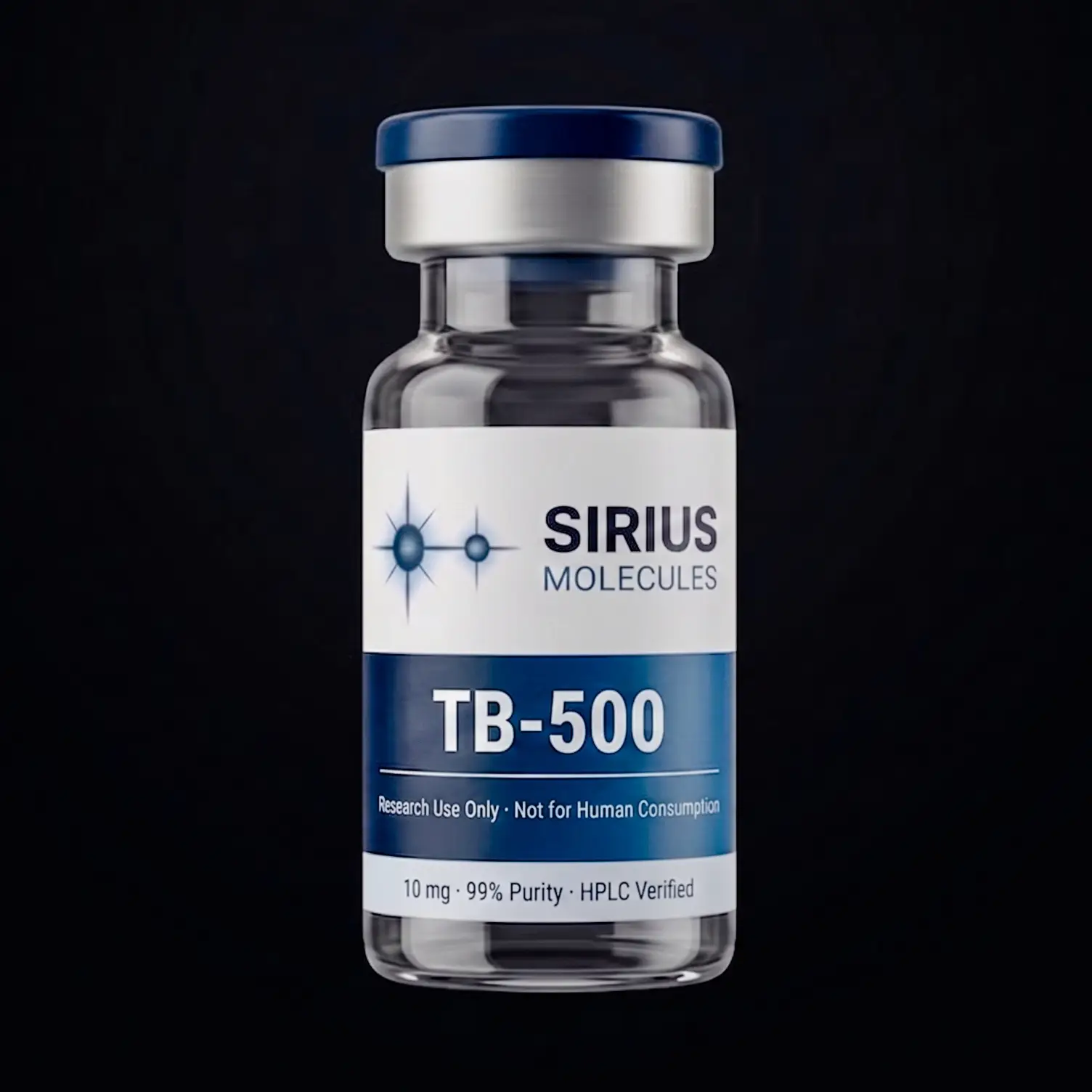
TB-500 is a synthetic peptide fragment derived from the actin-binding region of Thymosin Beta-4 (Tβ4), a naturally occurring protein found in virtually all mammalian cells. Since its characterization, TB-500 has been studied in preclinical models for its involvement in actin sequestration, cellular migration, and angiogenic pathway dynamics (Goldstein et al., 2005 — PMID: 16093480).
History
Thymosin Beta-4 was first isolated from bovine thymus tissue in the 1980s, with subsequent research identifying its primary biological activity as an actin-sequestering protein. TB-500 emerged from research efforts to develop a stable synthetic fragment retaining the actin-binding properties of the parent molecule. Over decades of research, TB-500 has been investigated across cardiac, dermal, neural, and musculoskeletal preclinical models (Sosne et al., 2010).
Structure & Molecular Data
| CAS Number | 77591-33-4 |
| Molecular Formula | C₂₁₂H₃₅₀N₅₆O₇₈S |
| Molecular Weight | 4,963.44 g/mol |
| Amino Acid Count / Structure | 43-amino-acid synthetic fragment |
| PubChem CID | 16132341 |
| Sequence | Ac-SDKP-NH-(peptide fragment, synthetic analog of Thymosin Beta-4 actin-binding domain) |
| Appearance | Lyophilized white powder |
| Storage | Store at -20°C. Protect from light. |
| Solubility | Soluble in sterile water and bacteriostatic water for research preparation |
Compound Class & Mechanism
TB-500 functions primarily as an actin-binding and actin-sequestering peptide in preclinical models. Its mechanism in experimental settings has been associated with regulation of actin polymerization dynamics, which plays a central role in cellular motility, shape, and structural organization.
Research has documented activity across multiple pathway contexts, including upregulation of laminin-5 expression in epithelial models, modulation of VEGF-mediated angiogenic signaling, and interaction with integrin-linked kinase pathways. These signaling contexts make TB-500 a frequently referenced research tool for investigating cellular remodeling dynamics (Malinda et al., 1999 — PMID: 10441561).
Research Findings
TB-500 has been investigated in controlled preclinical models spanning cardiac, dermal, ophthalmic, neural, and musculoskeletal biological systems. Published research has documented findings in the following domains:
Key Research Areas
- Cardiac Models: myocardial research, ventricular remodeling studies, ischemic tissue recovery models
- Dermal & Wound Models: epithelial migration dynamics, full-thickness tissue research
- Ophthalmic Research: corneal wound models, dry eye pathway studies
- Musculoskeletal Research: myocyte migration, collagen dynamics, tendon repair research models
Collectively, research activity across these diverse biological systems has established TB-500 as a widely referenced research peptide for investigating actin dynamics and tissue remodeling pathways in preclinical contexts (Sosne et al., Expert Opinion on Biological Therapy, 2015).
Research Context
Researchers study TB-500 to investigate the role of actin-sequestering peptides in cellular migration, angiogenesis, and structural remodeling pathways. The compound has been a subject of research interest across fields including cardiovascular biology, dermatology research, and regenerative medicine models. Its stability and activity across multiple experimental systems make it a commonly used comparator in pathway studies focused on cellular remodeling dynamics.
References
Goldstein AL. et al. (2005). Thymosin beta4: actin-sequestering protein moonlights to repair injured tissues. Trends in Molecular Medicine. PMID: 16093480
Malinda KM. et al. (1999). Thymosin beta4 accelerates wound healing. Journal of Investigative Dermatology. PMID: 10441561
Sosne G. et al. (2010). Thymosin beta 4 significantly reduces the signs of dryness in a murine controlled adverse environment model of experimental dry eye. Expert Opinion on Biological Therapy.
Bock-Marquette I. et al. (2004). Thymosin beta4 activates integrin-linked kinase and promotes cardiac cell migration, survival and cardiac repair. Nature. PMID: 15525989
Philp D. et al. (2003). Thymosin beta 4 increases hair growth by activation of hair follicle stem cells. FASEB Journal.
Sosne G. et al. (2015). Thymosin beta 4 therapy: current status and future directions. Expert Opinion on Biological Therapy.
Crockford D. et al. (2010). Thymosin beta4: structure, function, and biological properties supporting current and future clinical applications. Annals of the New York Academy of Sciences.
| REGULATORY & LEGAL NOTICE
Intended Use. This product is sold exclusively as a research chemical for use in controlled laboratory settings by qualified scientific professionals. It is intended solely for in vitro research, analytical standards, and non-clinical preclinical experimentation. The product is not a drug, dietary supplement, cosmetic, food product, or consumer article of any kind. Prohibited Uses. This product is NOT for use in humans, NOT for veterinary use, NOT for in vivo use in any species, NOT for diagnostic use, NOT for therapeutic use, NOT for food or agricultural use, and NOT for compounding into any preparation intended for administration to humans or animals. Qualified Professionals Only. Purchasers represent that they are qualified scientific professionals, licensed researchers, or authorized personnel at a research institution, and that this product will be handled in accordance with all applicable institutional, federal, state, and local regulations governing research chemicals. Regulatory Notice. The statements made regarding this product have not been evaluated by the U.S. Food and Drug Administration. This product has not been approved by the FDA for any therapeutic, diagnostic, or preventive use. Not a Compounding or Outsourcing Facility. Sirius Molecules is a research chemical supplier. Sirius Molecules is not a compounding pharmacy or outsourcing facility as defined under Sections 503A or 503B of the Federal Food, Drug, and Cosmetic Act. Legal Compliance. Purchasers are solely responsible for ensuring that their acquisition, possession, handling, and use of this product complies with all applicable laws and regulations in their jurisdiction. |