Overview
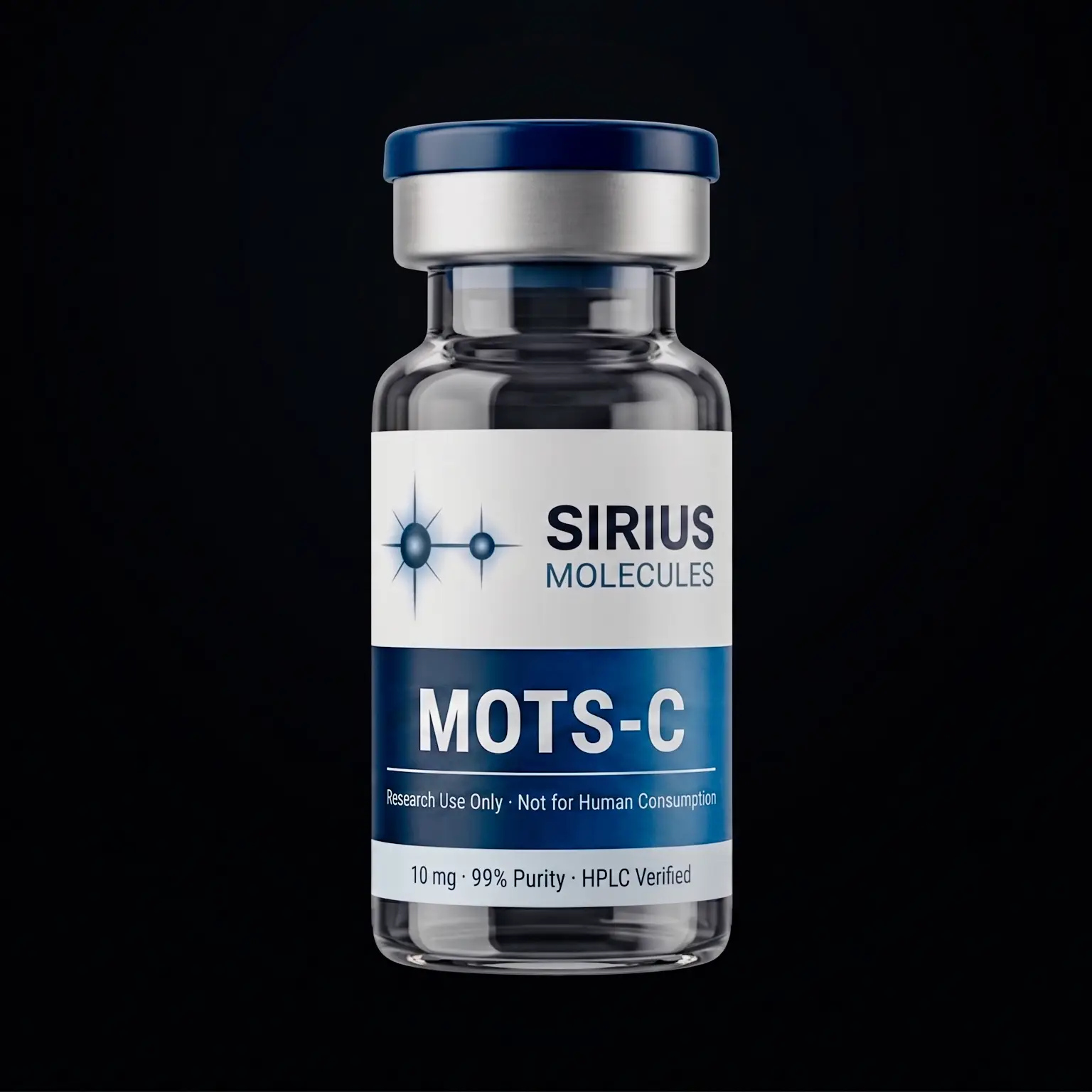
MOTS-c (Mitochondrial Open Reading Frame of the Twelve S rRNA-c) is a 16-amino-acid mitochondrial-derived peptide encoded within the 12S ribosomal RNA region of the mitochondrial genome. Since its discovery in 2015, MOTS-c has been studied in preclinical models for its involvement in AMPK signaling pathways, metabolic regulation, and cellular stress responses (Lee et al., 2015 — PMID: 25738459).
History
MOTS-c was discovered and characterized by researchers investigating the bioactivity of small open reading frames within the mitochondrial genome. Unlike nuclear-encoded peptides, MOTS-c represents a distinct class of signaling molecules of mitochondrial origin. Research has since expanded into metabolic, exercise physiology, and longevity-related pathway models (Kim et al., 2018).
Structure & Molecular Data
| CAS Number | 1627580-64-6 |
| Molecular Formula | C₇₈H₁₂₀N₁₉O₂₁S |
| Molecular Weight | 1,723.06 g/mol |
| Amino Acid Count / Structure | 16-amino-acid mitochondrial-derived peptide |
| PubChem CID | 91765321 |
| Sequence | Met-Arg-Trp-Gln-Glu-Met-Gly-Tyr-Ile-Phe-Tyr-Pro-Arg-Lys-Leu-Arg |
| Appearance | Lyophilized white powder |
| Storage | Store at -20°C. Protect from light. |
| Solubility | Soluble in sterile water for research preparation |
Compound Class & Mechanism
MOTS-c has been reported to activate AMP-activated protein kinase (AMPK) signaling in preclinical models, regulating cellular energy homeostasis. Research has documented activity affecting glucose uptake pathways, fatty acid oxidation, and the folate cycle through its interaction with AICAR metabolism.
The peptide has also been characterized as a nuclear-translocating signaling molecule under conditions of metabolic stress, interacting with nuclear transcription factors to regulate antioxidant and stress response gene expression. This bi-compartmental signaling behavior distinguishes MOTS-c from many other peptide research compounds (Kim et al., 2018 — PMID: 29514079).
Research Findings
MOTS-c has been investigated across preclinical models of metabolism, aging, and exercise physiology. Published research has documented findings in the following domains:
Key Research Areas
- Metabolic Research: AMPK pathway activation, glucose homeostasis in preclinical models
- Exercise Physiology: mitochondrial biogenesis and exercise response research
- Cellular Stress Response: nuclear translocation and stress-responsive transcription
- Aging Research: age-related metabolic decline in controlled research models
Collectively, these findings have established MOTS-c as a uniquely positioned research reference compound at the intersection of mitochondrial biology, metabolic research, and aging studies (Reynolds et al., 2021).
Research Context
Researchers study MOTS-c as a representative mitochondrial-derived peptide with implications for mitonuclear communication, metabolic regulation, and cellular stress biology. Its discovery has opened a research domain focused on the signaling roles of small peptides encoded within the mitochondrial genome, a previously underexplored area of molecular biology.
References
Lee C. et al. (2015). The mitochondrial-derived peptide MOTS-c promotes metabolic homeostasis and reduces obesity and insulin resistance. Cell Metabolism. PMID: 25738459
Kim KH. et al. (2018). The mitochondrial-encoded peptide MOTS-c translocates to the nucleus to regulate nuclear gene expression in response to metabolic stress. Cell Metabolism. PMID: 29514079
Reynolds JC. et al. (2021). MOTS-c is an exercise-induced mitochondrial-encoded regulator of age-dependent physical decline and muscle homeostasis. Nature Communications.
Mohtashami Z. et al. (2022). MOTS-c, the most recent mitochondrial derived peptide in human aging and age-related diseases. Journal of Molecular Medicine.
Ramanjaneya M. et al. (2019). Mitochondrial-derived peptides are down regulated in diabetes subjects. Frontiers in Endocrinology.
Cobb LJ. et al. (2016). Naturally occurring mitochondrial-derived peptides are age-dependent regulators of apoptosis, insulin sensitivity, and inflammatory markers. Aging.
| REGULATORY & LEGAL NOTICE
Intended Use. This product is sold exclusively as a research chemical for use in controlled laboratory settings by qualified scientific professionals. It is intended solely for in vitro research, analytical standards, and non-clinical preclinical experimentation. The product is not a drug, dietary supplement, cosmetic, food product, or consumer article of any kind. Prohibited Uses. This product is NOT for use in humans, NOT for veterinary use, NOT for in vivo use in any species, NOT for diagnostic use, NOT for therapeutic use, NOT for food or agricultural use, and NOT for compounding into any preparation intended for administration to humans or animals. Qualified Professionals Only. Purchasers represent that they are qualified scientific professionals, licensed researchers, or authorized personnel at a research institution, and that this product will be handled in accordance with all applicable institutional, federal, state, and local regulations governing research chemicals. Regulatory Notice. The statements made regarding this product have not been evaluated by the U.S. Food and Drug Administration. This product has not been approved by the FDA for any therapeutic, diagnostic, or preventive use. Not a Compounding or Outsourcing Facility. Sirius Molecules is a research chemical supplier. Sirius Molecules is not a compounding pharmacy or outsourcing facility as defined under Sections 503A or 503B of the Federal Food, Drug, and Cosmetic Act. Legal Compliance. Purchasers are solely responsible for ensuring that their acquisition, possession, handling, and use of this product complies with all applicable laws and regulations in their jurisdiction. |