Overview
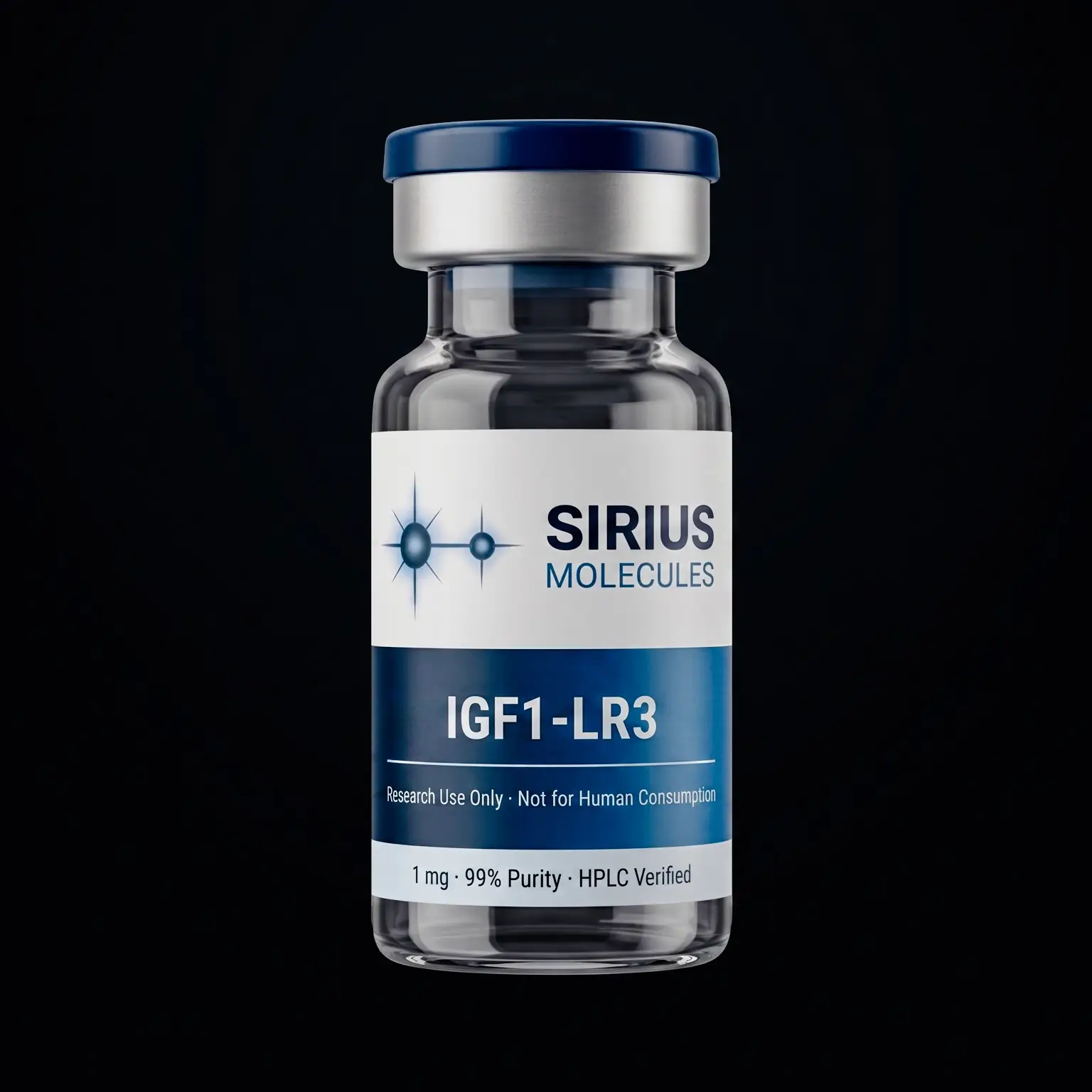
IGF1-LR3 (Long-Arg³ Insulin-like Growth Factor-1) is an 83-amino-acid synthetic analog of human IGF-1 modified by the addition of a 13-amino-acid N-terminal extension and substitution of arginine for glutamic acid at position 3 of the native IGF-1 sequence. These structural modifications dramatically reduce binding affinity for IGF-binding proteins (IGFBPs), extending the molecule’s circulating half-life and biological activity in preclinical research models (Tomas et al., 1993 — PMID: 8425977).
History
IGF1-LR3 was developed in the early 1990s as part of research efforts to design IGF-1 analogs with prolonged biological activity. The native IGF-1 protein has a short circulating half-life because over 99% of plasma IGF-1 binds to one of six IGF-binding proteins, particularly IGFBP-3, which sequesters the molecule. The Long-Arg³ modifications dramatically reduce IGFBP binding while preserving IGF-1 receptor (IGF-1R) affinity, resulting in a more bioavailable research tool for investigating IGF-1 axis biology (Francis et al., 1992).
Structure & Molecular Data
| CAS Number | 946870-92-4 |
| Molecular Formula | C₄₀₀H₆₂₅N₁₁₁O₁₁₅S₉ |
| Molecular Weight | 9,117.4 g/mol |
| Amino Acid Count / Structure | 83-amino-acid modified IGF-1 analog |
| PubChem CID | 16132340 |
| Sequence | Modified human IGF-1 with N-terminal 13-amino-acid extension and Arg³ substitution (Long-Arg³-IGF-1) |
| Appearance | Lyophilized white powder |
| Storage | Store at -20°C. Protect from light. |
| Solubility | Soluble in dilute acetic acid; reconstitution requires acidified buffer for research preparation |
Compound Class & Mechanism
IGF1-LR3 binds to the type 1 insulin-like growth factor receptor (IGF-1R), a receptor tyrosine kinase widely expressed across tissue types. Receptor activation in preclinical models has been associated with autophosphorylation of the receptor’s intracellular tyrosine kinase domain and downstream signaling through the PI3K-Akt and MAPK pathways. These pathways have been characterized in research models for their roles in cellular proliferation, survival signaling, and metabolic regulation.
The structural modifications in IGF1-LR3 (Arg³ substitution and N-terminal extension) reduce binding affinity for IGFBP-3 by approximately three orders of magnitude compared to native IGF-1. This results in a substantially larger fraction of free, bioavailable peptide in research preparations, with reported activity potency 2-3× higher than native IGF-1 in certain in vitro models. The modifications also confer extended stability against proteolytic degradation in research conditions (Francis et al., 1992 — PMID: 1639837).
Research Findings
IGF1-LR3 has been investigated in preclinical models spanning growth factor signaling, cellular proliferation research, and metabolic pathway studies. Published research has documented findings in the following domains:
Key Research Areas
- IGF-1R Pathway Research: receptor binding kinetics, downstream PI3K-Akt and MAPK signaling in preclinical models
- Cellular Proliferation: in vitro proliferation studies across multiple cell lines
- Musculoskeletal Models: myocyte differentiation and protein synthesis pathway research
- Comparative IGF-1 Research: stability and bioavailability profile comparisons against native IGF-1
Collectively, the IGF1-LR3 research literature has established the compound as a widely referenced research tool for investigating IGF-1 receptor pharmacology with extended bioavailability characteristics in preclinical environments (Tomas et al., 1993).
Research Context
Researchers study IGF1-LR3 to investigate IGF-1 axis biology in research designs requiring extended peptide bioavailability and reduced IGFBP-mediated sequestration. The compound’s modifications make it a distinct research tool compared to native IGF-1, particularly for in vitro studies where IGFBP confounding effects are undesirable.
References
Francis GL. et al. (1992). Insulin-like growth factor (IGF)-I and IGF-II in human breast carcinoma cells: structural variants. Journal of Molecular Endocrinology. PMID: 1639837
Tomas FM. et al. (1993). The insulin-like growth factor (IGF) analogues IGF-I, des(1-3)IGF-I, and Long-R3-IGF-I, but not bovine IGF-II, increase nitrogen retention in protein-deficient rats. The Journal of Endocrinology. PMID: 8425977
King R. et al. (1992). Insulin-like growth factor: current concepts and new developments in research. Hormone Research.
Ballard FJ. et al. (1991). Estimation of the level of IGF-binding proteins in serum and other biological fluids. Journal of Endocrinology.
Tomas FM. et al. (1993). Anabolic effects of insulin-like growth factor-I (IGF-I) and an IGF-I variant in normal female rats. Journal of Endocrinology.
Walton PE. et al. (1995). The IGFs and IGF-binding proteins in growth and metabolism. Domestic Animal Endocrinology.
| REGULATORY & LEGAL NOTICE
Intended Use. This product is sold exclusively as a research chemical for use in controlled laboratory settings by qualified scientific professionals. It is intended solely for in vitro research, analytical standards, and non-clinical preclinical experimentation. The product is not a drug, dietary supplement, cosmetic, food product, or consumer article of any kind. Prohibited Uses. This product is NOT for use in humans, NOT for veterinary use, NOT for in vivo use in any species, NOT for diagnostic use, NOT for therapeutic use, NOT for food or agricultural use, and NOT for compounding into any preparation intended for administration to humans or animals. Qualified Professionals Only. Purchasers represent that they are qualified scientific professionals, licensed researchers, or authorized personnel at a research institution, and that this product will be handled in accordance with all applicable institutional, federal, state, and local regulations governing research chemicals. Regulatory Notice. The statements made regarding this product have not been evaluated by the U.S. Food and Drug Administration. This product has not been approved by the FDA for any therapeutic, diagnostic, or preventive use. Not a Compounding or Outsourcing Facility. Sirius Molecules is a research chemical supplier. Sirius Molecules is not a compounding pharmacy or outsourcing facility as defined under Sections 503A or 503B of the Federal Food, Drug, and Cosmetic Act. Legal Compliance. Purchasers are solely responsible for ensuring that their acquisition, possession, handling, and use of this product complies with all applicable laws and regulations in their jurisdiction. |