
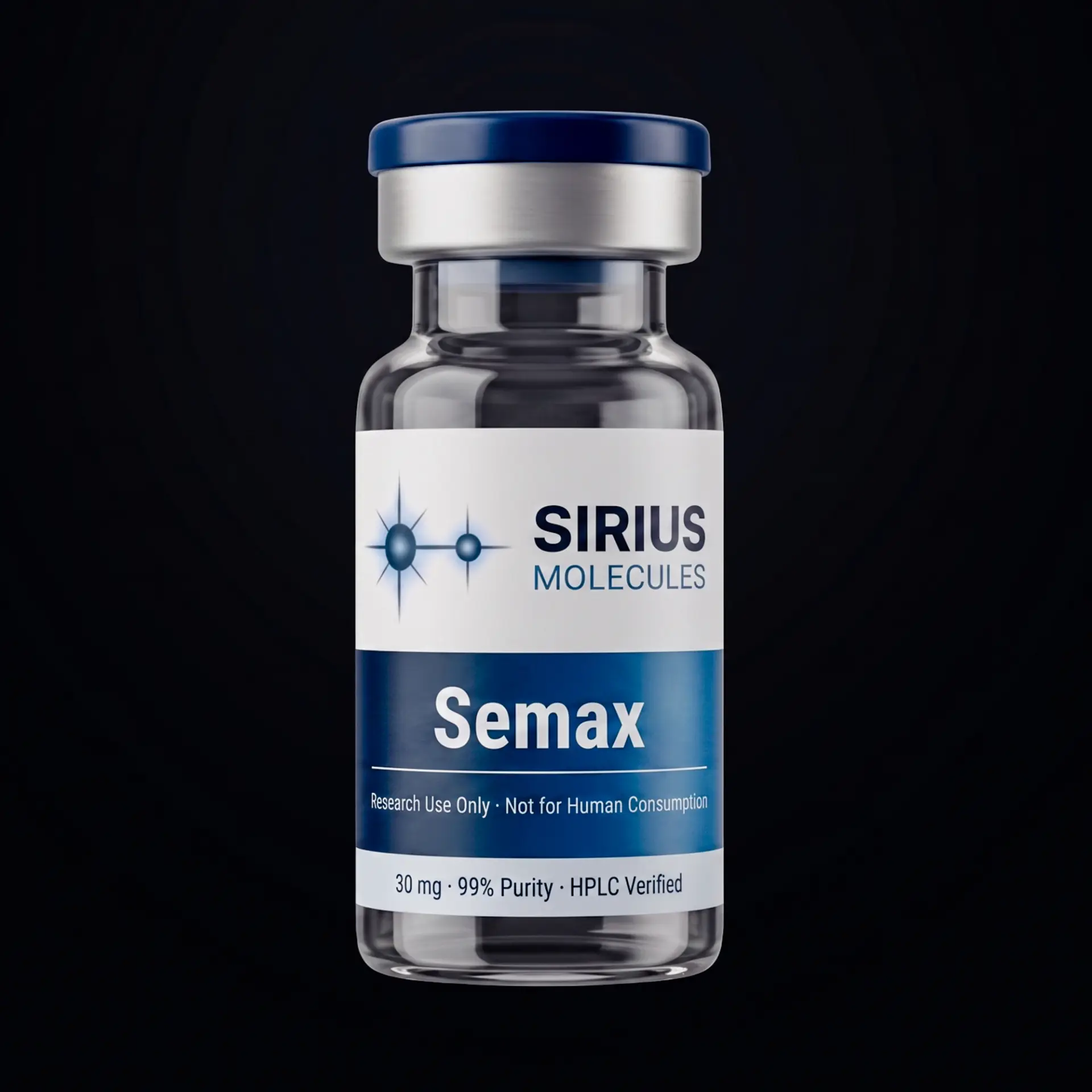
Overview
Semax is a synthetic heptapeptide analog of the ACTH(4-10) fragment, modified with a C-terminal Pro-Gly-Pro extension to confer metabolic stability. The compound has been studied extensively in preclinical research for its role in cognitive pathway research, neuroprotection models, and BDNF expression modulation (Ponomareva-Stepnaya et al., 1986 — foundational research).
History
Semax was developed in the 1980s-1990s at the Institute of Molecular Genetics of the Russian Academy of Sciences as a stabilized analog of the melanocortin fragment ACTH(4-10), which had shown cognitive-enhancing properties in earlier preclinical research. The addition of the C-terminal Pro-Gly-Pro extension prevents rapid degradation by peptidases, extending its pharmacological profile (Levitskaya et al., 2002).
Structure & Molecular Data
| CAS Number | 80714-61-0 |
| Molecular Formula | C₃₉H₅₄N₁₀O₁₁S |
| Molecular Weight | 886.98 g/mol |
| Amino Acid Count / Structure | 7-amino-acid synthetic heptapeptide |
| PubChem CID | 11765649 |
| Sequence | Met-Glu-His-Phe-Pro-Gly-Pro |
| Appearance | Lyophilized white powder |
| Storage | Store at -20°C. Protect from moisture. |
| Solubility | Soluble in sterile water and bacteriostatic water |
Compound Class & Mechanism
Semax has been reported to modulate BDNF (brain-derived neurotrophic factor) and NGF (nerve growth factor) expression in preclinical models, with research documenting effects on hippocampal and cortical neurotrophin signaling. Unlike full-length ACTH, Semax does not engage the melanocortin-2 receptor and lacks the steroidogenic activity characteristic of the parent hormone.
Research has additionally characterized Semax effects on dopaminergic and serotonergic systems in preclinical models, as well as effects on monoamine oxidase (MAO) activity and endogenous enkephalin degradation. These multi-system effects have positioned Semax as a distinctive research tool for investigating peptide-based neurotrophic pathway modulation (Shadrina et al., 2010).
Research Findings
Semax has been investigated in preclinical research spanning cognitive pathway studies, neuroprotection models, and neurotrophic factor research. Published research has documented findings in the following domains:
Key Research Areas
- Neurotrophic Factor Research: BDNF and NGF expression modulation in preclinical models
- Cognitive Pathway Research: memory and learning pathway studies in research models
- Neuroprotection: ischemic and hypoxic research models
- Monoaminergic Systems: dopaminergic and serotonergic pathway modulation
Collectively, Semax has been established as a widely referenced research reference compound for investigating peptide-based neurotrophic pathway modulation and cognitive research in preclinical environments (Dolotov et al., 2006).
Research Context
Researchers study Semax to investigate peptide-based modulation of neurotrophic factors and cognitive pathway biology in preclinical models. Its distinctive profile — retaining ACTH(4-10)-associated cognitive effects without the steroidogenic activity of full-length ACTH — makes it a useful research tool in neurotrophic pathway studies.
References
Ponomareva-Stepnaya MA. et al. (1986). Heptapeptide-analog of ACTH(4-7)-Pro-Gly-Pro: foundational research.
Levitskaya NG. et al. (2002). Neuroprotective effect of Semax in ischemic brain damage models. Bulletin of Experimental Biology and Medicine.
Shadrina MI. et al. (2010). Comparison of the effects of Semax and anti-ACTH serum on behavior and neurotrophin gene expression. Bulletin of Experimental Biology and Medicine.
Dolotov OV. et al. (2006). Semax, an analog of adrenocorticotropin (4-10), binds specifically and increases the level of brain-derived neurotrophic factor protein in rat basal forebrain. Journal of Neurochemistry.
Gusev EI. et al. (2005). Neuroprotective effects of Semax in acute ischemic stroke. Zhurnal Nevrologii i Psikhiatrii.
Glazova NY. et al. (2017). The neuroprotective effects of heptapeptide Semax in models of cerebral ischemia. Biomedicinskaia Khimiia.
| REGULATORY & LEGAL NOTICE
Intended Use. This product is sold exclusively as a research chemical for use in controlled laboratory settings by qualified scientific professionals. It is intended solely for in vitro research, analytical standards, and non-clinical preclinical experimentation. The product is not a drug, dietary supplement, cosmetic, food product, or consumer article of any kind. Prohibited Uses. This product is NOT for use in humans, NOT for veterinary use, NOT for in vivo use in any species, NOT for diagnostic use, NOT for therapeutic use, NOT for food or agricultural use, and NOT for compounding into any preparation intended for administration to humans or animals. Qualified Professionals Only. Purchasers represent that they are qualified scientific professionals, licensed researchers, or authorized personnel at a research institution, and that this product will be handled in accordance with all applicable institutional, federal, state, and local regulations governing research chemicals. Regulatory Notice. The statements made regarding this product have not been evaluated by the U.S. Food and Drug Administration. This product has not been approved by the FDA for any therapeutic, diagnostic, or preventive use. Not a Compounding or Outsourcing Facility. Sirius Molecules is a research chemical supplier. Sirius Molecules is not a compounding pharmacy or outsourcing facility as defined under Sections 503A or 503B of the Federal Food, Drug, and Cosmetic Act. Legal Compliance. Purchasers are solely responsible for ensuring that their acquisition, possession, handling, and use of this product complies with all applicable laws and regulations in their jurisdiction. |