Overview
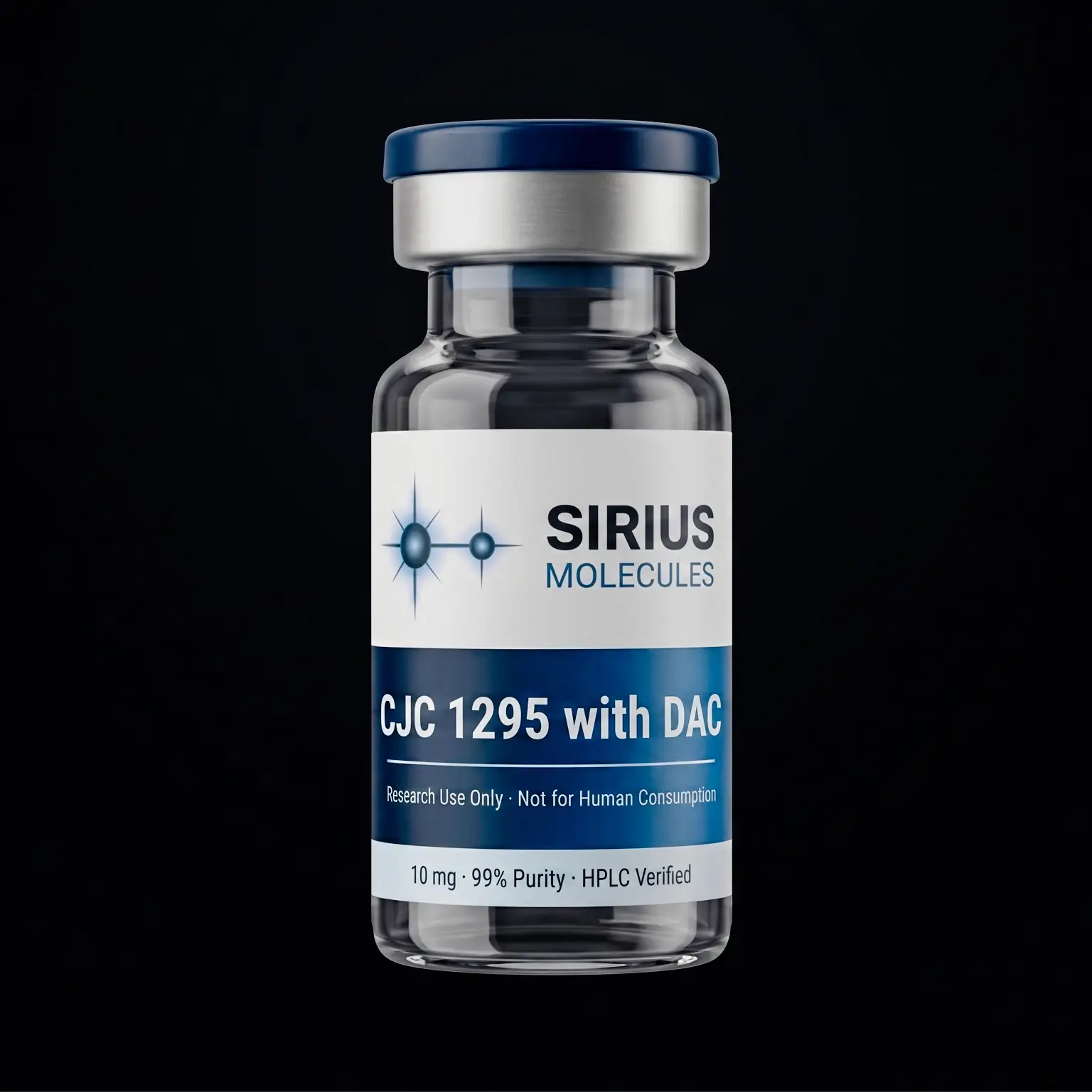
CJC-1295 with DAC (Drug Affinity Complex) is a synthetic 30-amino-acid analog of growth hormone releasing hormone (GHRH) featuring four amino acid substitutions for DPP-IV resistance plus an N-terminal maleimidopropionyl modification that enables covalent bonding to circulating serum albumin. This DAC modification dramatically extends the molecule’s circulating half-life relative to both native GHRH and the non-DAC variant of CJC-1295, supporting weekly research administration protocols (Teichman et al., 2006 — PMID: 16940447).
History
CJC-1295 was developed by ConjuChem Inc. in the early 2000s as part of research into long-acting GHRH analogs. The DAC variant was specifically designed to extend biological half-life through irreversible covalent binding to plasma albumin via lysine residues. Subsequent research has characterized the resulting sustained GHRH-R activation profile across pituitary, metabolic, and growth hormone axis research models (Ionescu & Frohman, 2006).
Structure & Molecular Data
| CAS Number | 863288-34-0 |
| Molecular Formula | C₁₆₅H₂₆₉N₅₁O₄₆ |
| Molecular Weight | 3,647.16 g/mol |
| Amino Acid Count / Structure | 30-amino-acid modified GHRH analog with DAC technology |
| PubChem CID | 56841945 |
| Sequence | Tyr-D-Ala-Asp-Ala-Ile-Phe-Thr-Gln-Ser-Tyr-Arg-Lys-Val-Leu-Ala-Gln-Leu-Ser-Ala-Arg-Lys-Leu-Leu-Gln-Asp-Ile-Met-Ser-Arg-Gln-(Lys-Maleimidopropionyl) — DAC modification |
| Appearance | Lyophilized white powder |
| Storage | Store at -20°C. Protect from light. |
| Solubility | Soluble in bacteriostatic water and sterile water for research preparation |
Compound Class & Mechanism
CJC-1295 with DAC binds to the growth hormone releasing hormone receptor (GHRH-R) expressed on anterior pituitary somatotrophs, activating cyclic AMP (cAMP) signaling cascades in preclinical models. Receptor activation has been associated with stimulated growth hormone release patterns in experimental settings.
The DAC modification enables the maleimide group on the peptide to form a covalent thioether bond with cysteine 34 of circulating human serum albumin within minutes of administration in research preparations. Once bound, the peptide-albumin conjugate circulates for an extended period — research has characterized half-lives of approximately 5-8 days in some preclinical models. This sustained activation profile differentiates the DAC variant from short-acting GHRH analogs and from the non-DAC version of CJC-1295, which retains a shorter pharmacodynamic profile (Teichman et al., 2006).
Research Findings
CJC-1295 with DAC has been investigated in preclinical and clinical research spanning growth hormone axis research, sustained GHRH-R activation studies, and metabolic pathway research. Published research has documented findings in the following domains:
Key Research Areas
- Sustained GHRH-R Activation: extended pharmacodynamic profile research in preclinical models
- Albumin Conjugation: covalent albumin binding kinetics and stability research
- GH/IGF-1 Axis: sustained GH and IGF-1 elevation profile studies
- Comparative GHRH Analog Research: DAC vs. non-DAC and other GHRH analog comparisons
Collectively, CJC-1295 with DAC has been established in research literature as the reference compound for sustained GHRH-R activation in preclinical environments, distinguished from shorter-acting GHRH analogs by its covalent albumin binding profile (Alba et al., 2006).
Research Context
Researchers study CJC-1295 with DAC to investigate sustained GHRH receptor activation in research designs requiring extended pharmacodynamic exposure. The compound is frequently referenced in studies comparing pulsatile (short-acting GHRH analog) versus sustained (DAC-modified) GHRH-R signaling profiles in preclinical models.
References
Teichman SL. et al. (2006). Prolonged stimulation of growth hormone (GH) and insulin-like growth factor I secretion by CJC-1295, a long-acting analog of GH-releasing hormone. JCEM. PMID: 16940447
Ionescu M., Frohman LA. (2006). Pulsatile secretion of growth hormone (GH) persists during continuous stimulation by CJC-1295. JCEM.
Alba M. et al. (2006). Once-daily administration of CJC-1295, a long-acting GHRH analog, normalizes growth hormone in male patients with adult-onset GH deficiency. JCEM.
Jetté L. et al. (2005). hGRF1-29-albumin bioconjugates activate the GRF receptor on the anterior pituitary in rats. Endocrinology.
Sackmann-Sala L. et al. (2009). GHRH and its analogs: potential applications in muscle biology. Growth Hormone & IGF Research.
Gagliardi A., Maioli M. (2013). Peptide therapies and the pituitary-GH-IGF-1 axis. Hormones (Athens).
| REGULATORY & LEGAL NOTICE
Intended Use. This product is sold exclusively as a research chemical for use in controlled laboratory settings by qualified scientific professionals. It is intended solely for in vitro research, analytical standards, and non-clinical preclinical experimentation. The product is not a drug, dietary supplement, cosmetic, food product, or consumer article of any kind. Prohibited Uses. This product is NOT for use in humans, NOT for veterinary use, NOT for in vivo use in any species, NOT for diagnostic use, NOT for therapeutic use, NOT for food or agricultural use, and NOT for compounding into any preparation intended for administration to humans or animals. Qualified Professionals Only. Purchasers represent that they are qualified scientific professionals, licensed researchers, or authorized personnel at a research institution, and that this product will be handled in accordance with all applicable institutional, federal, state, and local regulations governing research chemicals. Regulatory Notice. The statements made regarding this product have not been evaluated by the U.S. Food and Drug Administration. This product has not been approved by the FDA for any therapeutic, diagnostic, or preventive use. Not a Compounding or Outsourcing Facility. Sirius Molecules is a research chemical supplier. Sirius Molecules is not a compounding pharmacy or outsourcing facility as defined under Sections 503A or 503B of the Federal Food, Drug, and Cosmetic Act. Legal Compliance. Purchasers are solely responsible for ensuring that their acquisition, possession, handling, and use of this product complies with all applicable laws and regulations in their jurisdiction. |