
The research compound industry runs on certificates of analysis that anyone with a PDF editor can forge. Here’s how we eliminated that problem — and what we’re adding to every batch starting June 2026.
The Integrity Problem in Research Compound Supply
If you’ve spent any time evaluating peptide suppliers, you’ve already learned the uncomfortable truth: a certificate of analysis is supposed to be proof, but in this industry, it’s just a claim.
Batch numbers get recycled across years of shipments. Chromatograms get pulled from one supplier’s archive and rebranded with another vendor’s logo. The same “clean” COA shows up across fifteen different storefronts with fifteen different batch numbers. And the file metadata? Often shows a creation date from 2019.
For researchers, this isn’t an inconvenience — it’s a structural failure of the data pipeline. A research compound is only as valid as the analytical certainty behind it. If the COA can’t be trusted, the experiment can’t be trusted, and the publication can’t be defended.
Sirius Molecules was built to solve this problem at the source. That starts with how we test, where we test, and how the resulting data is preserved.
Why Third-Party Testing Is Non-Negotiable
Internal testing creates a conflict of interest no disclaimer can resolve. The lab that depends on the supplier for revenue cannot be expected to flag the supplier’s own failures. Even when conducted in good faith, in-house QC data carries an unavoidable credibility discount — and rightly so.
Third-party analytical testing solves this by separating the financial relationship from the analytical judgment. The lab’s product is the data. Its reputation depends on the integrity of that data, not on the supplier’s preference for a favorable result.
But third-party testing alone is no longer enough. As the industry has matured, so have the fraud vectors:
- PDF tampering — COA PDFs can be edited in any modern editor; watermarks can be removed or AI-replaced
- Golden sample fraud — one clean sample tested while bulk inventory ships untouched
- COA recycling — a single legitimate lab report reused across batches indefinitely
- Dry labs — facilities that generate plausible-looking results without ever running an instrument
A printed COA, however authentic at the moment of creation, has no defense against any of these once it leaves the lab. The document and the analysis are decoupled the instant the PDF is exported.
This is the problem Accumark Labs set out to solve, and it is why they are the lab of record for every Sirius Molecules batch.
The Accumark Verification Stack
Accumark is a US-based independent analytical laboratory (Anaheim, California) purpose-built for research compound and peptide verification. Their analytical capabilities cover the standard panel — identity confirmation by mass spectrometry, purity quantification by reversed-phase HPLC, mass balance, and counterion content — but the analytical work is only half of what makes them the right partner. The other half is the verification architecture surrounding the data.
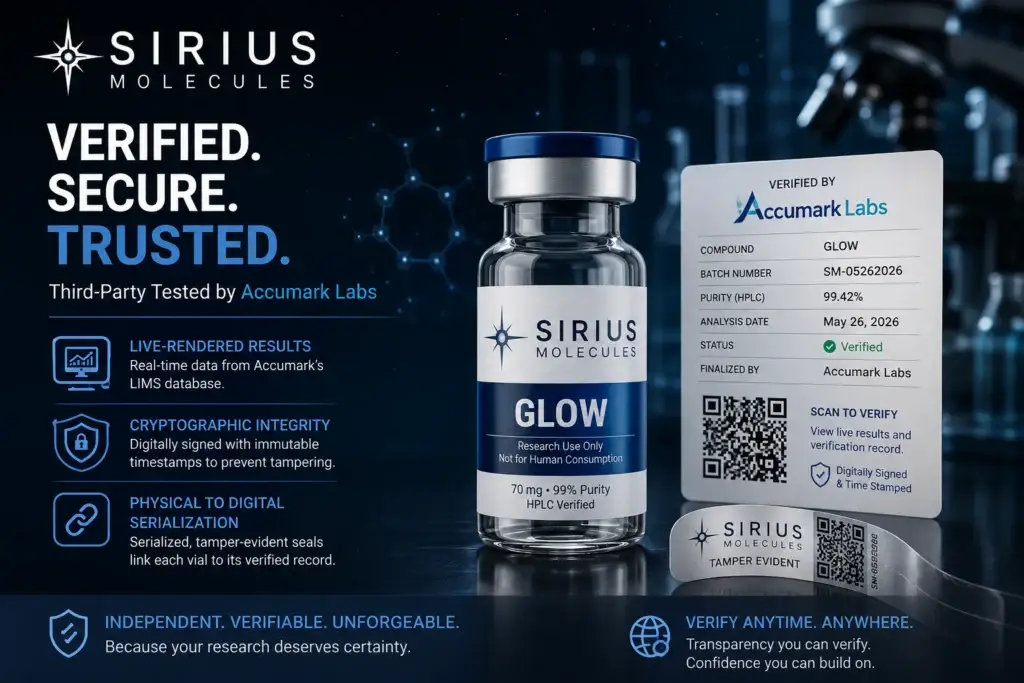
Accumark’s system is built on three layers, each of which closes a specific fraud vector that traditional COAs leave open.
1. Live-Rendered Results From a LIMS Database
Every Accumark report exists as a live record rendered directly from their Laboratory Information Management System (LIMS), not as a static file. Each report has a unique, permanent URL. When that URL is loaded, the page queries the authoritative database and renders the current data in real time. The “document” is the database itself.
The practical consequence: there is no PDF to edit, no file to swap on a server, no document to forge. A copy of the COA can be saved or printed for archival purposes, but the source of truth always lives at the verification URL.
2. Cryptographic Signing and Immutable Timestamps
When Accumark finalizes a result, the data is cryptographically hashed and digitally signed. This creates a permanent, mathematically verifiable record that the data existed in its specific form at a specific moment.
The implications are absolute. Even if an attacker compromised Accumark’s database and altered a historical record, the signature would no longer match the hash of the modified data — and the mismatch would be immediately detectable on verification. The signature is not a graphic on the COA. It is a cryptographic proof embedded in the record itself.
This is the same class of integrity guarantee used to anchor financial transactions and certificate authorities. It is mathematically the strongest form of data attestation currently available, and it raises the cost of fraud from “trivial” to “computationally infeasible.”
3. Physical-to-Digital Serialization
For premium testing tiers, Accumark provides tamper-evident seals with serialized identifiers that link the physical vial to its digital record. The QR on the seal resolves to the verification URL for that exact unit. Once broken, the seal cannot be reapplied without visible evidence — which prevents the most common form of downstream substitution.
What This Means for Sirius Molecules Customers
Every Sirius Molecules batch includes an Accumark COA that anyone can independently verify at any time by scanning a code or clicking a link.
The verification process is deliberately simple:
- Locate the verification URL or QR code on the COA tied to your product order
- Open the URL in any browser
- Confirm that the compound, batch number, purity, and finalization timestamp on the live-rendered record match what was shipped
- The cryptographic signature is verified automatically by the verification page
If the live record cannot be located, or if the data does not match the COA, the result is invalid by definition. We encourage every customer to verify every batch. The architecture exists precisely because verification should be the default behavior of any research procurement workflow.
You can explore the verification portal directly at accumarklabs.com/verify.
Coming June 2026: Endotoxin and Sterility Testing on Every Forward Batch
Beginning with all batches produced from June 2026 onward, Sirius Molecules will add two additional assays to our standard release panel for every product:
Bacterial Endotoxin Testing (USP <85>) — Quantitative measurement of lipopolysaccharide content via the Limulus Amebocyte Lysate (LAL) assay, reported in endotoxin units per milligram (EU/mg). Endotoxin contamination is invisible to HPLC and mass spectrometry. A compound can test at 99%+ chemical purity and still carry endotoxin loads that render it unsuitable for any application involving cellular or live-system research models. Endotoxin contamination is one of the most common findings cited in FDA warning letters issued to compounding facilities, and it is a known confound in countless in vitro and in vivo research outcomes.
Sterility Testing (USP <71>) — Detection of viable microbial contamination via membrane filtration or direct inoculation methodology, with 14-day incubation across appropriate growth media. Sterility testing closes the gap that purity and endotoxin assays cannot — confirming that no viable bacterial or fungal organisms are present in the finished product at the time of release.
Together, these two assays elevate the Sirius Molecules release standard from chemical characterization to full biosafety profiling. We are adopting these requirements because we believe they should be the floor, not the ceiling, for any research compound supplier operating in a serious capacity. The cost is absorbed into our standard pricing.
This expansion will be reflected on every Accumark COA produced after the cutover, and on every product page across the catalog.
Stay Informed
Sirius Molecules publishes batch release data, expanded testing announcements, new product launches, and regulatory developments relevant to the research compound space directly to our subscriber list.
If you want to be notified when a new batch hits release, when the endotoxin and sterility data starts appearing on COAs, or when we expand the testing panel further, contact us to be added to the announcement list. We do not share the list, we do not run promotional pushes, and we do not send anything that isn’t directly relevant to the integrity and availability of the catalog.
The standard for research compound supply should be higher than it is. We’re building Sirius Molecules to be the company that operates as if that standard were already in place.
All Sirius Molecules products are sold strictly for research use only (RUO) and are not intended for human or veterinary consumption, diagnostic use, or therapeutic application. Independent analytical verification is provided through Accumark Labs, an unaffiliated third-party laboratory.